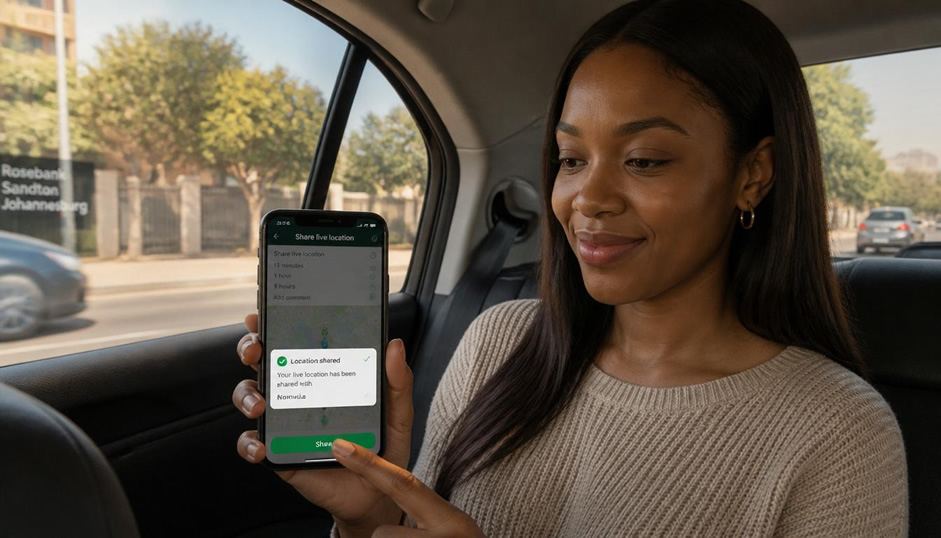
For millions of South Africans, carpooling is no longer just a nice idea — it is a financial necessity.
With petrol prices continuing to climb, e-toll debates ongoing, and the daily reality of sitting in traffic on the N1, N3, or M1, sharing a ride with colleagues or neighbours has become one of the most sensible commuting decisions you can make. It cuts costs, reduces wear on your vehicle, and for many people, takes the edge off a stressful morning.
But as carpooling becomes more common, so does an important question that comes up in conversations around safety — particularly among women, parents, and anyone commuting with people they do not know well:
Should I share my live location during a carpool?
For most South African commuters, the answer is a straightforward yes. Here is why it matters, when to use it, and how to do it without overcomplicating things.
Why Live Location Sharing Is Worth Getting Used To
Carpooling — especially in the early stages of a new arrangement — involves placing a degree of trust in people you may not know particularly well. Most of the time that trust is entirely warranted. But unexpected things do happen on South African roads, and not all of them are dramatic. Route changes, breakdowns, unusual stops, uncomfortable behaviour — these are all situations where having someone track your journey in real time can make a meaningful difference.
Live location sharing creates a simple but powerful layer of accountability. It means that someone who cares about you knows exactly where you are, from the moment you get in the car to the moment you arrive safely. If something deviates from the expected route or timeline, they can check in immediately rather than waiting anxiously for a message that has not arrived.
In a country where personal safety is a genuine daily consideration, that kind of quiet oversight is not paranoia — it is just smart.
It Gives the People Who Care About You Peace of Mind
Many South Africans commute significant distances every day — often leaving home before sunrise and returning after dark. For spouses, parents, siblings, and close friends, that journey can be a source of quiet anxiety, particularly when the commute involves unfamiliar people or routes.
Live location sharing removes a lot of that uncertainty. Instead of waiting for a "home safe" message or sending a string of check-in texts, a trusted contact can simply glance at their phone and confirm your journey is progressing as expected. No fuss, no repeated calls, no unnecessary worry.
It is a small gesture that makes a real difference to the people in your corner.
It Can Actively Help if Something Goes Wrong
This is where live location sharing moves from being a reassurance tool to being a genuine safety mechanism. If a carpool situation becomes uncomfortable — a driver who will not explain a route change, behaviour that is making you uneasy, or a stop that was never part of the plan — the fact that someone is already watching your journey gives you immediate backup.
A trusted contact monitoring your live location can:
- Notice if your route changes unexpectedly and message you to check in
- Spot unusual stops that do not match your expected journey
- Call you with a reason to engage with the outside world, subtly changing the dynamic in the vehicle
- Contact emergency services with your precise location if they cannot reach you
All of this happens without any confrontation inside the car — which is often exactly what you need.
When You Should Always Share Your Location
While building live location sharing into every carpool is a good habit, there are specific situations where it moves from recommended to essential.
Your First Trip With Someone New
Even if an arrangement seems perfectly legitimate — a colleague's contact, someone from a verified platform, a neighbour of a neighbour — the first trip is always the one with the most unknowns. Share your location every time without exception until trust is established through consistent, positive experience.
Night-Time Travel
South Africa's statistics around night-time safety are well documented. If your commute starts early in the morning or ends after dark, live location tracking is particularly valuable. Quieter roads and reduced visibility make real-time monitoring more important, not less.
Long-Distance or Highway Commutes
Travelling across cities or on major highways — the N3 between Joburg and Durban, the N2 in the Western Cape, or long stretches of the N1 — puts you further from help if something goes wrong. Sharing your location on these routes means someone always has visibility over your progress.
Any Time Something Feels Off
If something about the driver, a fellow passenger, or the route gives you a moment of unease, share your location immediately. Do not wait to see if the feeling passes. Trust your instincts and act on them early.
How to Do It Properly
Use WhatsApp's Built-In Feature
Most South Africans already use WhatsApp daily, which makes its live location feature the most practical option for the majority of commuters. Open a chat with your trusted contact, tap the attachment icon, and select "Location" then "Share Live Location." You can set it for 15 minutes, 1 hour, or 8 hours — choose a duration that covers your journey with a little extra time built in.
Only Share With People You Actually Trust
Your live location should go to someone specific — a family member, a close friend, or a trusted colleague who you know will pay attention. This is not something to share broadly or leave running indefinitely. Be deliberate about who has visibility and for how long.
Let Your Contact Know What to Watch For
A quick message before you leave goes a long way. Something as simple as: "I'm carpooling home — keeping an eye on my location would be appreciated. Should be there by 6." means they know to actually monitor it rather than just receiving a notification and moving on.
Consider a Dedicated Safety App
For commuters who want more functionality, apps like bSafe and MySOS offer features beyond basic location sharing — including panic buttons, automatic alerts, and the ability to trigger an emergency notification to multiple contacts simultaneously. Both are worth having installed alongside your regular WhatsApp setup.
It Is a Habit, Not a Statement About Trust
Some commuters hesitate to share their location because they worry it implies they do not trust their carpool partner. It does not — and any reasonable person will understand that.
Wearing a seatbelt does not mean you expect to be in an accident. Locking your car does not mean you expect it to be stolen. Sharing your live location during a carpool is the same kind of quiet, sensible precaution — one that says nothing about the people you are travelling with and everything about being a thoughtful, prepared commuter.
Responsible drivers and passengers respect it. Anyone who pushes back on such a basic safety habit is, ironically, giving you useful information.
Safety Works Best in Layers
Live location sharing is most effective when it sits alongside other commuting safety habits. Verify who you are sharing a ride with before the first trip. Agree on pickup and drop-off points in public spaces. Share vehicle details with a trusted contact. Trust your instincts when something does not feel right.
No single precaution eliminates all risk — but multiple small habits layered together create a commuting routine that is genuinely safer and significantly more confident.
Carpooling in South Africa should do what it is meant to do: save you money, reduce your stress, and make the daily commute more manageable. A few simple safety habits ensure it stays that way.
Ready to find a verified commuter on your route?
Browse active lift clubs near you ?