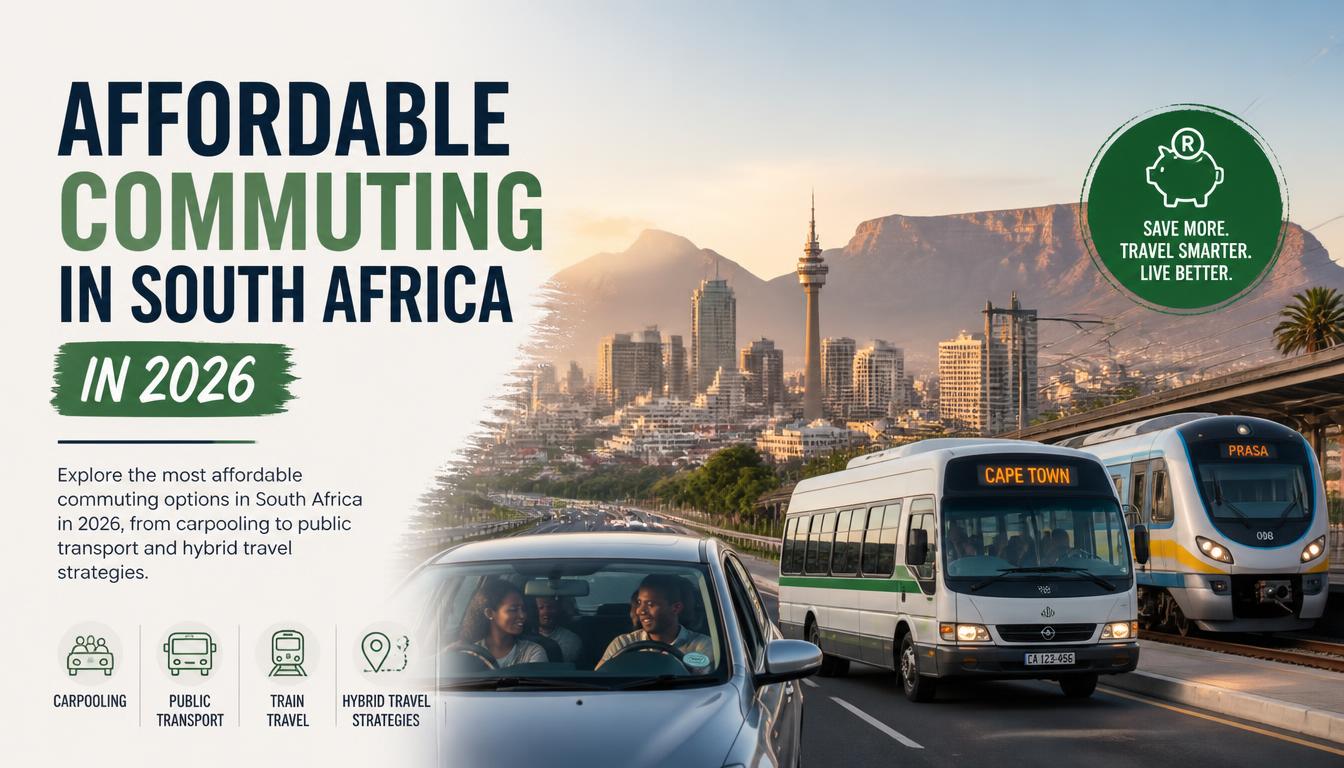
For many South Africans, getting to work is one of the biggest recurring expenses in the monthly budget.
Whether you are travelling into Johannesburg, Sandton, Pretoria, Durban, Cape Town or another major business centre, the cost of commuting can quickly add up.
Fuel, parking, taxis, buses, train fares, tolls and vehicle maintenance all take money out of your salary before you have even started paying for groceries, electricity or other household expenses.
So what is actually the cheapest way to get to work in South Africa in 2026?
The answer depends on where you live, how far you travel, what transport options are available, and whether you are prepared to share the journey with other commuters.
In this guide, we compare the main commuting options and look at how you can reduce your daily transport costs.
What Is the Cheapest Way to Commute?
There is no single cheapest option for everyone.
For someone living a few kilometres from work, walking or cycling could cost almost nothing.
For someone travelling 40 kilometres each way, those options may not be realistic.
In general, the cheapest options tend to be:
- Walking or cycling for short distances
- Public transport where routes are convenient
- Carpooling and lift clubs
- Employer-provided transport
- Combining different transport options
Driving alone is usually one of the more expensive ways to commute once the full cost of vehicle ownership is considered.
Walking to Work
If you live close enough to your workplace, walking is difficult to beat on price.
There is no fuel bill, parking fee, toll, vehicle maintenance or public transport fare.
Walking also provides an opportunity to get some physical activity into your day.
However, safety and distance must come first.
Walking may not be practical for commuters travelling long distances or through areas where pedestrian safety is a concern.
Cycling to Work
Cycling can also be an extremely affordable commuting option.
After the initial cost of a suitable bicycle and safety equipment, your ongoing costs can be relatively low.
Basic maintenance such as tyres, brakes and servicing still needs to be considered, but these costs are generally much lower than operating a car.
The biggest challenge in South Africa is finding a route where cycling can be done safely and comfortably.
Traffic, weather, road conditions and secure bicycle parking all need to be considered.
Using Minibus Taxis
Minibus taxis are one of the most widely used forms of daily transport in South Africa.
For commuters without access to a private vehicle, they can be a relatively affordable way to travel.
The total cost depends heavily on your route.
A commuter who needs one taxi each way will have a very different monthly cost from someone who needs two or three connections.
Convenience and availability can also vary significantly between routes.
Using Buses
Bus services can be an economical alternative to driving, particularly for commuters living near established routes.
Services such as Rea Vaya, MyCiTi and other municipal or regional bus networks provide alternatives to private vehicle commuting in certain parts of South Africa.
The main advantage is that you avoid the large ownership costs associated with a car.
You do not have to pay for:
- Fuel
- Vehicle insurance
- Servicing
- Tyres
- Vehicle depreciation
The disadvantage is that you are limited by the available routes, timetables and stops.
Using Trains
Where reliable train services are available, rail can be one of the more affordable ways to travel longer distances.
For commuters with convenient access to stations, trains can eliminate many of the costs associated with driving.
However, availability, reliability, security and the distance between the station and your final destination all need to be considered.
For some commuters, the most practical solution is a combination of walking, a short taxi trip and rail.
The Gautrain
The Gautrain provides a fast and convenient option for commuters travelling between parts of Gauteng.
It can be particularly useful for people travelling between Johannesburg, Sandton, Midrand and Pretoria.
However, convenience does not necessarily mean it is the cheapest option.
Your total cost may include the train fare, parking at the station, or a connecting bus or taxi.
For commuters who live close to a station and work close to another station, the Gautrain can still offer excellent value when the time saved is considered.
Driving Your Own Car
Driving alone offers the greatest flexibility.
You decide when to leave, which route to take and where to stop.
But it can also be one of the most expensive commuting choices.
Your actual cost includes much more than fuel.
- Fuel
- Parking
- Tolls
- Insurance
- Maintenance
- Tyres
- Repairs
- Depreciation
For example, a commuter spending R2,000 a month on fuel is not really spending only R2,000 on commuting.
The vehicle is also accumulating kilometres and wear every time it travels to work.
Carpooling Can Change the Calculation
This is where carpooling becomes particularly interesting.
Instead of one person paying the full cost of a daily commute, several people share the same journey.
Imagine four people who normally drive separately to the same area.
One vehicle could potentially carry all four commuters.
The driver receives a reasonable contribution towards the cost of the journey, while the passengers avoid the full cost of running their own vehicles.
Everyone can potentially save money.
Why Lift Clubs Can Be One of the Cheapest Options
A well-organised lift club can offer many of the benefits of private transport without requiring every commuter to own and operate a vehicle for the journey.
Passengers can avoid:
- Daily fuel expenses
- Parking costs
- Vehicle maintenance
- Additional mileage on their own vehicles
The driver also benefits because passengers can contribute towards the reasonable running costs of the vehicle.
This makes a lift club potentially beneficial for both sides.
How Much Could You Save?
Consider a simplified example.
Suppose driving alone costs you R3,000 per month when fuel, parking and other commuting expenses are considered.
If joining a lift club reduces your personal commuting cost to R1,500 per month, you could save:
- R1,500 per month
- R18,000 per year
- R90,000 over five years
Even a smaller saving of R500 per month adds up to R6,000 per year.
The actual saving depends on the route, number of passengers, vehicle costs and agreed contribution.
Employer Transport
Some employers provide staff transport, shuttle services or transport allowances.
If your employer offers a transport option, find out exactly what it costs you.
A company shuttle may be significantly cheaper than driving yourself, particularly if parking at your workplace is expensive.
If there is no existing service, it may also be worth asking whether other employees travel from the same area.
You may discover an opportunity to create an informal lift club.
Combine Different Transport Options
You do not necessarily need to use the same transport method for your entire journey.
Combining transport options can sometimes provide the best balance between cost, convenience and travel time.
For example:
- Walk to a nearby bus stop
- Use a taxi to reach a train station
- Drive to a Gautrain station and take the train
- Carpool part of the journey with colleagues
Think about your commute as a complete journey rather than assuming you must drive from your front door to your workplace.
Do the Monthly Calculation
The easiest way to find the cheapest option is to calculate your current monthly transport cost.
Include:
- Fuel
- Parking
- Tolls
- Taxi or bus fares
- Train fares
- Maintenance allowance
- Occasional ride-hailing costs
Then compare that number with the alternatives available to you.
Don't Only Compare Money
The cheapest option on paper is not necessarily the best option.
You should also consider:
- Travel time
- Safety
- Reliability
- Convenience
- Flexibility
Saving R1,000 a month may not be worthwhile if your new commute adds three hours to your day.
On the other hand, saving R1,000 while travelling with trusted colleagues could be an excellent trade-off.
Think About the Annual Saving
One of the best ways to motivate yourself to reduce commuting costs is to look at the yearly figure.
Saving R1,000 per month means R12,000 per year.
Saving R1,500 per month means R18,000 per year.
Over several years, those savings can become significant.
That money could be used to reduce debt, build an emergency fund, invest for retirement, or simply give you more breathing room in your monthly budget.
Conclusion
The cheapest way to get to work in South Africa in 2026 depends on your individual circumstances.
Walking and cycling can be extremely cheap for short distances, while buses, taxis and trains can offer affordable alternatives for longer journeys.
For many commuters who would otherwise drive alone, however, carpooling and lift clubs can provide an excellent balance between affordability, convenience and flexibility.
The important thing is to calculate the full cost of your current commute rather than looking only at the price of petrol or a daily transport fare.
Once you know what your commute is really costing you, you can make an informed decision about where to save.
What is the cheapest way you have found to get to work in South Africa?