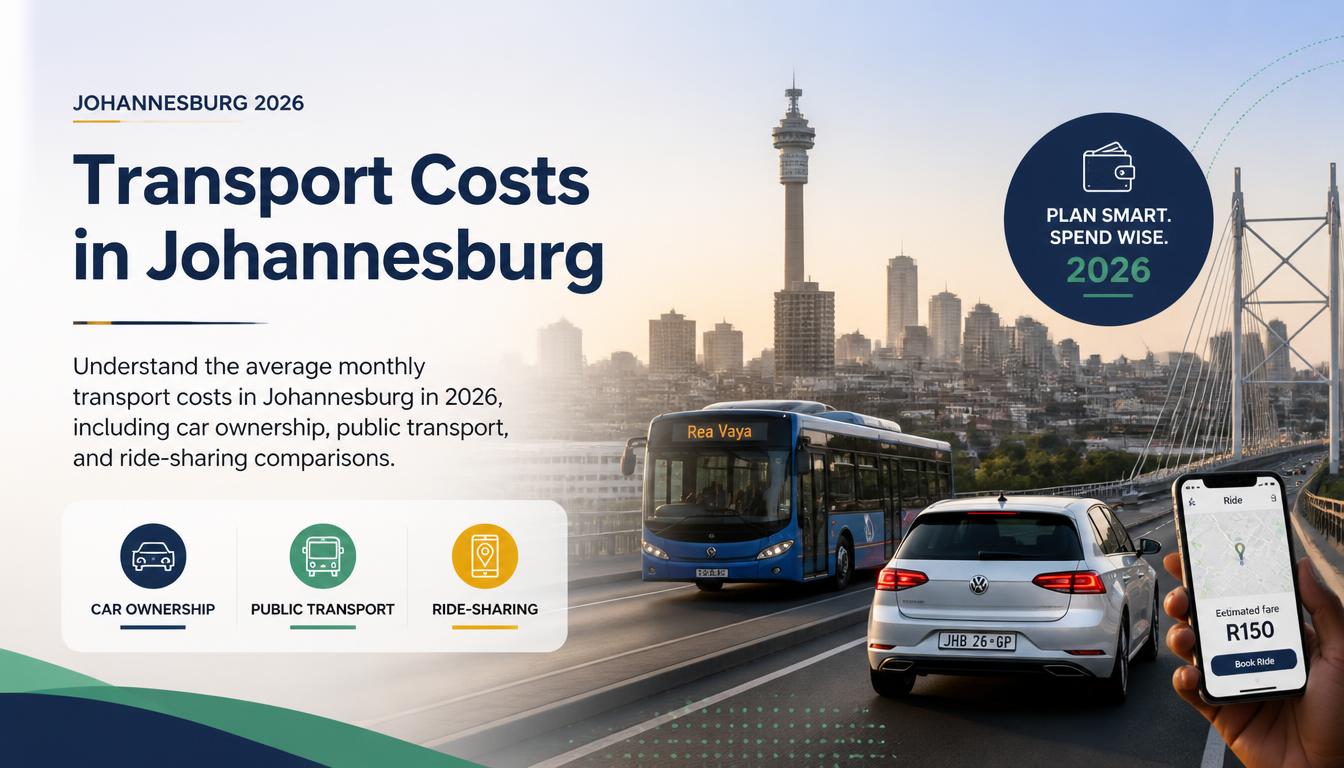
For many Johannesburg residents, getting to work is one of the biggest expenses in the monthly budget.
It is easy to underestimate the true cost of commuting because transport expenses are spread across fuel, parking, public transport, vehicle maintenance and the occasional unexpected repair.
A commuter might look at a R1,500 fuel bill and think that is the cost of getting to work. But the real figure can be considerably higher once all the other costs are included.
In 2026, understanding your monthly transport cost is more important than ever.
Whether you drive your own car, use the Gautrain, take a taxi, use a bus, or participate in a lift club, knowing what you are spending can help you make better financial decisions.
Here is what Johannesburg commuters should expect to spend each month and how different transport options compare.
Why Johannesburg Commuting Can Be Expensive
Johannesburg is a sprawling city.
Many people live far from where they work, with daily journeys between areas such as Roodepoort, Randburg, Midrand, Sandton, Centurion and the Johannesburg CBD.
A 20 or 30 kilometre commute each way quickly becomes hundreds of kilometres every month.
That distance creates costs beyond simply buying petrol.
Your monthly transport expenses may include:
- Fuel
- Parking
- Tolls
- Public transport fares
- Vehicle maintenance
- Tyres
- Vehicle depreciation
Driving Your Own Car
Driving your own car is still one of the most convenient ways to commute in Johannesburg.
You can leave when you want, choose your own route, and avoid having to coordinate your schedule with other people.
But convenience comes at a price.
Fuel
Consider a commuter travelling 50 kilometres per day.
If the vehicle averages 8 litres per 100 kilometres, the car would use approximately 4 litres of fuel per day.
Over 20 working days, that is roughly 80 litres.
At an example fuel price of R25 per litre, the monthly fuel cost would be approximately R2,000.
Your actual cost will depend on the current fuel price, vehicle consumption, traffic and the distance travelled.
Parking
Parking can add a surprisingly large amount to your monthly transport budget.
Some employers provide free parking, while others require employees to pay monthly or daily parking fees.
Even R50 per working day adds approximately R1,000 per month.
Tolls
Some Johannesburg commuters also use toll roads.
If your route includes tolls, calculate the cost for both directions and multiply it by the number of days you commute.
A seemingly small daily toll can become a significant monthly expense.
The Hidden Cost of Owning a Car
Your transport budget should also account for the costs associated with operating the vehicle.
These include:
- Servicing
- Oil and filters
- Tyres
- Brake components
- Battery replacement
- Mechanical repairs
You may not pay these expenses every month, but they still form part of the long-term cost of commuting.
Setting aside a monthly amount for maintenance can prevent an unexpected repair from destroying your budget.
Vehicle Depreciation
Another cost that is often forgotten is depreciation.
Every additional kilometre adds mileage to your vehicle.
If you drive 1,000 kilometres a month just getting to work, that is approximately 12,000 kilometres a year before considering weekends and other journeys.
Higher mileage can affect the future resale or trade-in value of your vehicle.
Although depreciation does not appear as a monthly debit order, it is still a real cost of commuting.
Using the Gautrain
For commuters who live and work near Gautrain stations, the Gautrain can be an attractive alternative to driving.
The monthly cost depends on the stations used, peak or off-peak travel, and whether you need additional transport to reach your final destination.
There may also be parking costs if you drive to the station.
One advantage is that your travel costs can be easier to predict than driving during heavy traffic.
The Gautrain fare calculator can be used to check current fares for a specific route.
Using Minibus Taxis
Minibus taxis remain one of the most widely used forms of public transport in Johannesburg.
They can be significantly cheaper than travelling alone in a private vehicle.
However, the total monthly cost depends on your route and how many taxis you need to use to reach work.
If you need two taxis each way, for example, your monthly transport cost can be substantially higher than someone who only needs a single trip each way.
Bus Transport
Bus services can provide another affordable commuting option where routes are convenient.
Johannesburg commuters may use services such as Rea Vaya or other bus networks depending on where they live and work.
The biggest advantage is that you avoid many of the ownership costs associated with a private vehicle.
You do not have to pay for fuel, servicing, tyres, insurance or vehicle depreciation.
The trade-off is that you are restricted to the available routes and schedules.
Carpooling and Lift Clubs
Carpooling can offer an interesting middle ground between public transport and driving alone.
Instead of every commuter driving their own vehicle, several people share one journey.
The driver can receive a reasonable contribution towards the cost of the trip while passengers avoid paying the full cost of operating their own vehicle.
For example, if four commuters share a vehicle, the driver's fuel cost can potentially be divided between the group.
This can reduce the monthly transport cost for everyone while also reducing the number of vehicles travelling during peak hours.
A Simple Monthly Comparison
There is no single transport cost that applies to every Johannesburg commuter, but a simplified example can help illustrate the difference.
- Private vehicle: potentially R2,000 or more for fuel alone
- Private vehicle with parking and tolls: potentially R3,000 to R5,000 or more
- Gautrain: depends heavily on the stations and frequency of travel
- Bus or taxi: generally lower than private vehicle ownership costs, depending on the route
- Lift club: potentially much lower than driving alone, depending on the agreed contribution and number of passengers
These figures are examples rather than fixed Johannesburg transport prices. Your actual monthly cost will depend on your route, travel frequency, vehicle and transport choices.
Don't Forget Occasional Transport Costs
Your monthly budget should also allow for expenses that do not happen every week.
These might include:
- Ride-hailing trips when your normal transport is unavailable
- Emergency taxi fares
- Vehicle repairs
- Additional parking
- Weekend travel
Keeping a small transport emergency fund can make these expenses easier to handle.
How to Reduce Your Monthly Transport Cost
If commuting is taking too much of your salary, there are several ways to reduce the cost.
Consider a Lift Club
Sharing your commute with colleagues or other people travelling in the same direction can significantly reduce fuel and vehicle expenses.
Combine Transport Options
You do not necessarily have to choose one transport method for every journey.
For example, you could drive to a Gautrain station and use the train for the remainder of your journey.
Reduce Unnecessary Driving
Working from home occasionally, combining errands, or carpooling for certain days can reduce your monthly mileage.
Track Your Actual Costs
For one month, record every transport-related expense.
Include fuel, parking, tolls, taxis, ride-hailing, maintenance and other costs.
You may be surprised by the final number.
Look at the Annual Cost
Monthly transport costs can look manageable when viewed in isolation.
But multiply the figure by 12 and the picture changes.
A commuter spending R3,000 per month on transport is spending R36,000 per year.
At R4,000 per month, the annual figure becomes R48,000.
Over five years, that becomes R240,000.
This is why reducing your commuting costs by even R500 or R1,000 per month can have a meaningful impact on your long-term finances.
Conclusion
There is no universal monthly transport cost for Johannesburg.
Someone living close to work may spend relatively little, while a commuter travelling 30 or 40 kilometres each way can easily spend several thousand rand every month.
The important thing is to calculate your complete cost rather than looking only at fuel or public transport fares.
Once you understand what your commute is really costing you, you can compare alternatives such as carpooling, lift clubs, buses, taxis and the Gautrain.
For many Johannesburg workers, reducing commuting costs could free up hundreds or even thousands of rand every month.
How much do you spend on transport each month to get to work in Johannesburg?