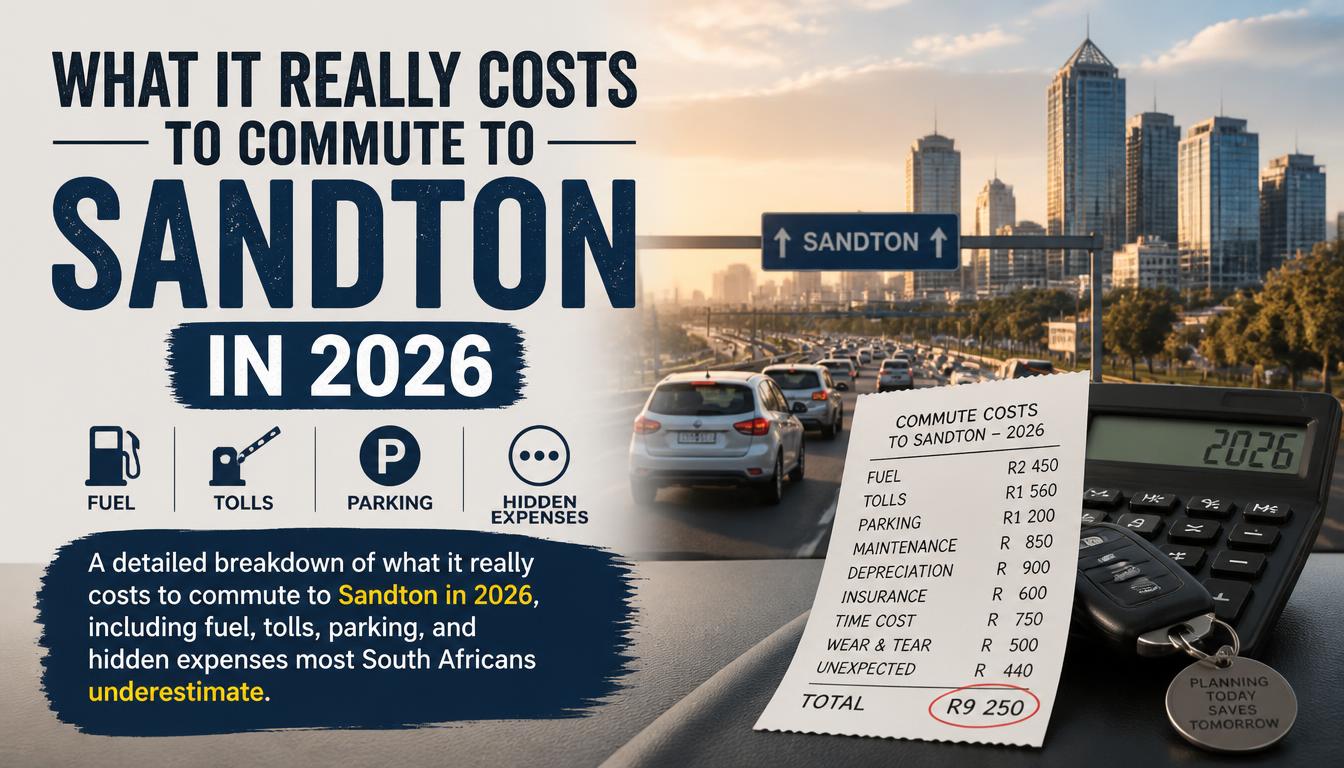
For thousands of South Africans, travelling to Sandton every weekday is simply part of working life.
Whether you are heading into the Sandton CBD, Sandown, Illovo, Rosebank, Bryanston, Rivonia or one of the surrounding business districts, the daily commute can take a surprisingly large bite out of your salary.
At first, the cost may not seem too bad.
It is only fuel, right?
But once you add parking, tolls, vehicle maintenance, tyres, insurance and the occasional unexpected repair, the true cost of commuting by car can be considerably higher than the amount you see on your petrol station receipt.
And that is exactly why carpooling and lift clubs are becoming increasingly attractive to South African workers.
In this guide, we will break down the typical costs involved in commuting to Sandton in 2026 and look at how much you could potentially save by sharing the journey with other commuters.
The Real Cost of Driving to Sandton
The biggest mistake commuters make when calculating their transport costs is looking only at fuel.
Your actual commuting cost can include:
- Fuel
- Parking
- Tolls
- Vehicle servicing
- Tyres
- Vehicle depreciation
- Insurance
Some of these costs are obvious while others are hidden in your monthly vehicle expenses.
Fuel Costs
Fuel is usually the first expense people consider.
However, the amount you spend depends heavily on the distance you travel, your vehicle's fuel consumption and traffic conditions.
Consider a commuter travelling approximately 50 kilometres per day in total.
If the vehicle averages 8 litres per 100 kilometres, the daily fuel requirement would be approximately 4 litres.
At a hypothetical fuel price of R25 per litre, that works out to roughly:
- R100 per day
- R500 per five-day working week
- R2,000 per 20-day working month
- Approximately R24,000 per year over 240 working days
The actual petrol price changes during the year, so your real cost could be higher or lower. Gauteng fuel prices are adjusted periodically based on factors including international petroleum prices and the exchange rate. :contentReference[oaicite:1]{index=1}
Traffic Makes Fuel Consumption Worse
Johannesburg traffic can make the fuel calculation even more painful.
A vehicle that achieves excellent fuel consumption on an open road may use considerably more fuel during stop-start peak-hour traffic.
Long periods of idling, frequent acceleration and braking, and slow-moving traffic all contribute to increased fuel consumption.
This means your actual Sandton commuting cost can be higher than a simple distance calculation suggests.
Parking in Sandton
Parking can be one of the biggest hidden costs of working in Sandton.
Depending on where you work, you may have free company parking, subsidised parking, or a significant monthly parking bill.
Even a relatively modest parking charge of R50 per working day would add:
- R250 per week
- R1,000 per month
- Approximately R12,000 per year
Premium parking closer to your workplace can cost substantially more.
This is why two people travelling the same distance to Sandton can have very different commuting costs.
What About Toll Roads?
For commuters travelling from areas such as the West Rand, Pretoria, Midrand or other parts of Gauteng, toll roads may form part of the journey.
The cost depends on the route and how frequently you use the toll road.
If you pay R30 in tolls each way, for example, that would be:
- R60 per day
- R300 per week
- R1,200 per 20-day month
- Approximately R14,400 over 240 working days
That is before adding fuel.
Vehicle Maintenance Is Part of Your Commute
Every kilometre you drive contributes to the gradual wear and tear of your vehicle.
Your commuting costs therefore include more than petrol and parking.
Over time, you will need to pay for:
- Oil and filter services
- Tyres
- Brake components
- Wheel alignment
- Battery replacement
- Other mechanical repairs
The more kilometres you drive, the sooner these expenses arrive.
Vehicle Depreciation
Depreciation is one of the easiest commuting costs to ignore.
Every additional kilometre adds to the mileage on your vehicle.
A car travelling 25,000 or 30,000 kilometres a year can experience considerably more wear and mileage-related depreciation than a vehicle that only travels 10,000 kilometres annually.
You do not receive a monthly bill for depreciation, but it can affect the amount your vehicle is worth when you eventually sell or trade it.
Insurance and Other Fixed Costs
Insurance, vehicle licensing and finance costs are not caused entirely by commuting, so they should not necessarily be allocated fully to your daily trip.
However, using your vehicle for a long daily commute contributes to the overall cost of owning and operating that vehicle.
This is another reason why calculating only your petrol expenditure can give you a misleading picture.
What Could a Sandton Commute Actually Cost?
Let us consider a realistic example.
Imagine a commuter travelling 25 kilometres each way to Sandton, or approximately 50 kilometres per day.
Assume:
- 8 litres per 100 km fuel consumption
- R25 per litre fuel cost for the example
- 20 working days per month
- R1,000 monthly parking
- No toll costs
The fuel component would be approximately R2,000 per month.
Add R1,000 for parking and the direct monthly commuting cost becomes approximately R3,000.
That is already R36,000 per year.
And this still excludes maintenance, tyres, depreciation and other vehicle ownership costs.
What Happens If You Carpool?
This is where lift clubs become interesting.
Suppose four commuters travel together in one vehicle.
If the group agrees to share the reasonable cost of the journey, the driver's fuel expense could potentially be divided between the commuters.
Using the R2,000 monthly fuel example, dividing the fuel cost between four people would work out to approximately R500 per person per month.
Even if you add a reasonable contribution towards vehicle wear and other running costs, the saving compared with everyone driving separately can be substantial.
The Driver Can Benefit Too
A common misconception is that only passengers benefit from lift clubs.
The driver can benefit significantly as well.
Instead of carrying the entire cost of the daily commute, the driver can receive agreed contributions from passengers.
This can help offset:
- Fuel
- Maintenance
- Tyres
- Vehicle wear
The important part is agreeing on a fair contribution before the arrangement begins.
Carpooling Can Save More Than Money
The financial saving is only one benefit.
Sharing a commute can also reduce the number of vehicles on the road.
Four people travelling in one vehicle means three fewer cars making the same journey.
It can also make the daily commute less stressful.
Instead of spending every morning alone behind the wheel, commuters can share the journey, listen to music, chat, or simply relax while someone else drives.
What About the Gautrain?
The Gautrain is another option for people working in Sandton.
For commuters living near a station, it can be a convenient alternative to driving all the way into the Sandton CBD.
However, the total cost depends on your starting station, whether you need a connecting bus, and whether you use parking.
Gautrain fares are based on the route and time of travel, with peak and off-peak pricing applying. The official Gautrain fare calculator can be used to check the current cost for a particular journey. :contentReference[oaicite:2]{index=2}
Sandton Station also provides parking and drop-off facilities with 24-hour security, making it an option worth considering for commuters who drive part of the journey and use the train for the rest. :contentReference[oaicite:3]{index=3}
Which Option Is Cheapest?
There is no single answer for every commuter.
Your cheapest option depends on where you live, where you work, how far you travel, and whether your employer provides parking.
For example:
- A commuter living close to Sandton with free workplace parking may find driving convenient.
- A commuter travelling a long distance with toll costs may benefit considerably from carpooling.
- Someone living near a Gautrain station may find public transport more convenient.
- A group of colleagues travelling from the same area may save substantially by forming a lift club.
Calculate Your Own Commuting Cost
The easiest way to understand your situation is to calculate the full monthly cost.
Start with your approximate monthly fuel cost.
Then add:
- Parking
- Tolls
- Estimated maintenance
- Tyres and other wear items
You can then compare this figure with the cost of carpooling, the Gautrain, buses, or other transport options.
The Bigger Picture
A commuting cost of R3,000 per month may not sound dramatic when viewed one month at a time.
But over five years, that is R180,000.
And if your actual cost is R4,000 per month, the five-year figure becomes R240,000.
That is a significant amount of money that could otherwise be used for paying off debt, investing, saving for retirement, or simply improving your monthly cash flow.
Conclusion
Commuting to Sandton is expensive, and the true cost is often much higher than the amount spent at the petrol station.
Fuel, parking, tolls, maintenance, tyres and vehicle depreciation all contribute to the cost of getting to work.
For many Johannesburg commuters, sharing the journey through a lift club can be one of the simplest ways to reduce these expenses.
The important thing is to look beyond the daily fuel bill and calculate what your commute is really costing you each month and each year.
Once you know the number, you can make a much better decision about whether driving alone, carpooling, using the Gautrain, or combining different transport options makes the most financial sense.
How much do you currently spend each month commuting to Sandton?